
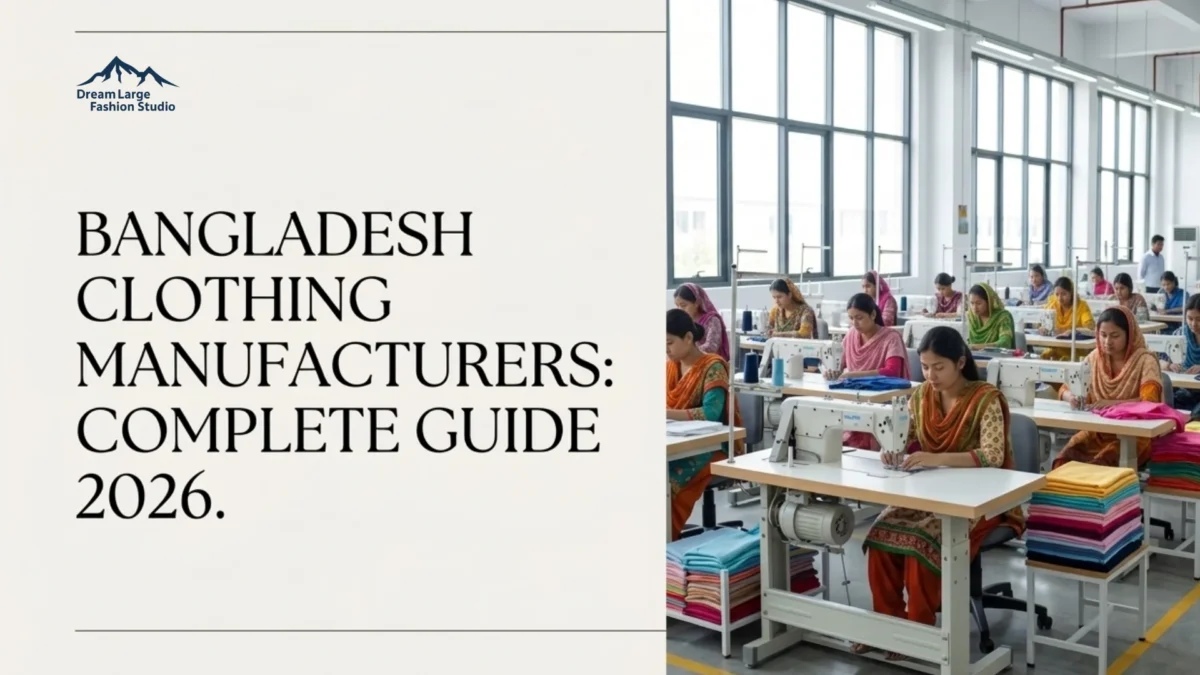
Bangladesh stands as the world’s second-largest apparel exporter, with over 3,500 factories producing garments for major international brands. For buyers seeking competitive pricing without sacrificing quality, Bangladesh offers a compelling combination of skilled labor, modern infrastructure, and improving ethical standards.
Whether you’re launching a new fashion line or scaling an existing brand, understanding Bangladesh’s clothing manufacturing landscape helps you make smarter sourcing decisions. This guide explains what makes Bangladesh manufacturers competitive, how to evaluate potential partners, and what to expect when working with factories in Dhaka, Gazipur, and other production hubs.
WHY BANGLADESH DOMINATES GLOBAL APPAREL MANUFACTURING
Bangladesh earned its position through decades of investment in textile infrastructure and workforce development. The country exported over $47 billion worth of garments in 2024, with projections reaching $60 billion by 2026.
Labor costs remain significantly lower compared to China, Turkey, or Eastern Europe. Entry-level workers earn $110 to $150 per month, which translates to competitive FOB pricing for buyers. But cost is just one advantage.
The textile ecosystem includes vertical integration. Many factories control everything from yarn spinning to finished garment production. This setup reduces lead times, improves quality control, and provides flexibility for order adjustments. Production zones like Dhaka, Gazipur, Chittagong, and Narayanganj house hundreds of LEED-certified green factories with modern machinery from Japan, Germany, and Italy.
Pro Tip: Look for factories with Accord or RMG Sustainability Council certifications. These show commitment to safety and ethical practices beyond basic compliance.
Production Capacity by Category
| Product Category | Monthly Capacity Range | Typical MOQ | Lead Time |
| Basic T-shirts & Polos | 200,000 – 500,000 pcs | 3,000 – 5,000 pcs/style | 45-60 days |
| Woven Shirts | 150,000 – 300,000 pcs | 2,000 – 3,000 pcs/style | 60-75 days |
| Denim Jeans | 100,000 – 250,000 pcs | 2,500 – 4,000 pcs/style | 75-90 days |
| Activewear & Leggings | 180,000 – 400,000 pcs | 3,000 – 5,000 pcs/style | 50-65 days |
TYPES OF CLOTHING MANUFACTURERS IN BANGLADESH
Not all Bangladesh manufacturers operate the same way. Understanding factory types helps match your production needs with the right partner.
Knitwear Manufacturers
These factories specialize in knitted fabrics like jersey, interlock, rib, and fleece. They produce t-shirts, polos, hoodies, sweatpants, and underwear. Most knitwear factories run circular knitting machines and own dyeing units, giving better control over color consistency and fabric quality. Knitwear represents roughly 60% of Bangladesh’s total apparel exports.
If your brand focuses on casual wear, athleisure, or basics, knitwear manufacturers offer faster turnaround and lower MOQs compared to woven production. Many handle orders as small as 1,200 pieces per color per style, though 3,000 pieces provides better pricing.
Woven Garment Producers
Woven specialists manufacture shirts, trousers, dresses, jackets, and workwear using fabrics like poplin, twill, oxford, and canvas. These factories typically require higher MOQs since woven production involves more complex processes including pattern making, cutting, fusing, and multiple quality checkpoints.
Woven manufacturers maintain relationships with fabric mills in China, India, or local suppliers. Lead times run longer because fabric procurement adds 15-20 days to the production cycle. However, quality standards for woven garments tend to be rigorous, making Bangladesh factories competitive globally.
Composite and Vertically Integrated Facilities
Composite factories handle the entire production chain under one roof, from spinning yarn to finishing garments. These facilities offer the fastest lead times and tightest quality control since they don’t rely on external fabric suppliers. While MOQs might be higher, composite manufacturers provide more flexibility for rush orders and last-minute changes. Around 30% of Bangladesh’s large manufacturers now operate as composite units.
Quick Selection Guide:
- For basics and casualwear → Choose knitwear specialists
- For formal and structured pieces → Select woven producers
- For mixed collections with tight deadlines → Go with composite factories
- For small trial orders → Find factories accepting 1,500-2,000 pc MOQs
HOW TO EVALUATE BANGLADESH MANUFACTURERS BEFORE PARTNERING
Finding a factory is easy. Finding the right factory takes research. Buyers who skip proper vetting often face quality issues, missed deadlines, or communication problems that hurt their brand.
Start with certifications and audit reports. Every legitimate Bangladesh manufacturer should hold at least one major compliance certification like WRAP, BSCI, Sedex, or GOTS for organic production. These show the factory meets international labor standards, maintains safe conditions, and follows environmental regulations.
Request copies of recent audit reports from brands they work with. Look for scores above 80% in categories like fire safety, chemical management, and worker welfare. Factories that openly share this information demonstrate transparency.
Be Cautious: Some trading companies pose as manufacturers to mark up prices. Always verify by requesting:
- Business license and export registration
- Factory photos with dated timestamps
- Video call tour of production floor
- Contact details of at least 2 current clients
Production capacity matters more than factory size. A manufacturer with 800 workers might produce 150,000 pieces monthly, while another with 1,200 workers struggles to hit 100,000 pieces due to inefficient workflows. Ask about current capacity utilization. Factories running at 85-95% capacity have healthy order books but can still accommodate new buyers. Those below 70% might face financial stress, while factories above 98% will likely delay your orders.
Communication quality predicts partnership success. During initial conversations, notice response speed, whether they ask detailed questions about requirements, and if they offer solutions when something isn’t feasible. Good manufacturers act as partners, not just order takers. They’ll point out potential tech pack issues and suggest improvements based on production experience.
Expert Insight: “I’ve worked with Bangladesh factories for 12 years. The best ones never promise what they can’t deliver. If a factory immediately agrees to your impossible timeline or unrealistic price without pushback, that’s a red flag. Professional manufacturers negotiate honestly and explain their constraints.” – Sarah Chen, Sourcing Director
COST STRUCTURE AND PRICING IN BANGLADESH MANUFACTURING
Understanding how Bangladesh manufacturers price products helps you negotiate fairly. Garment costing typically breaks down: fabric and trims account for 55-65% of total cost, labor represents 12-18%, overhead and utilities take 8-12%, and factory profit margin runs 8-15% depending on order volume and complexity.
For a basic 180 GSM cotton jersey t-shirt, expect FOB prices between $2.80 and $4.20 depending on print complexity, trim quality, and order quantity. A woven cotton shirt with button-down collar typically costs $6.50 to $9.80 FOB. Denim jeans range from $8.20 to $14.50 based on wash type and hardware.
MOQs directly impact unit cost. A 5,000-piece order might cost $3.20 per t-shirt, while 15,000 pieces of the same style drops the price to $2.85. This happens because factories spread setup costs across more units. Cutting room setup, screen printing preparation, and quality inspection overhead stay relatively fixed whether you order 2,000 or 10,000 pieces.
Bangladesh vs China Pricing Comparison
| Garment Type | Bangladesh FOB | China FOB | Cost Savings |
| Basic T-shirt (180gsm) | $2.80 – $3.40 | $4.20 – $5.10 | 28-35% |
| Polo Shirt | $4.50 – $6.20 | $6.80 – $9.20 | 30-33% |
| Woven Shirt | $6.50 – $8.80 | $9.50 – $12.40 | 31-38% |
| Denim Jeans | $9.20 – $12.80 | $13.50 – $18.20 | 32-42% |
*Prices based on 10,000 piece orders, January 2026 data
Payment terms vary by manufacturer and relationship length. New buyers typically pay 30% deposit with tech pack approval, 60% before shipment, and 10% against document copies. After 3-4 successful orders, many factories offer 30-day payment terms or LC at sight. Some large manufacturers work with financing partners to offer 60-90 day terms for established brands.
QUALITY STANDARDS AND MANUFACTURING PROCESSES
Bangladesh manufacturers have dramatically improved quality control over the past decade, moving from basic inspection to comprehensive quality management systems. Modern factories implement AQL standards throughout production rather than just checking finished garments.
Quality starts with fabric inspection when material arrives from suppliers. Technicians check for shade variations, defects per linear meter, and dimensional stability through washing tests. Approved fabric moves to cutting, where automated spreading machines ensure accuracy within 2mm tolerance.
During sewing, inline quality checkers inspect every 15th garment for stitch quality, seam strength, and measurement accuracy. This catches problems early before large quantities get produced incorrectly. Final inspection happens after finishing, where auditors check 100% of garments using AQL 2.5 standards. Defect rates above 2.5% trigger rework or rejection.
Standard Quality Control Workflow:
- Fabric Inspection: 4-point system check, shrinkage test, colorfastness verification
- Pre-Production Meeting: Review tech pack, create production sample, approve trims
- Cutting QC: Verify marker efficiency, check cutting accuracy, bundle preparation
- Inline Inspection: Random checks every 30 minutes during sewing operations
- Final Audit: AQL 2.5 inspection before packing, metal detection, measurement verification
Testing capabilities separate good manufacturers from great ones. Look for factories with in-house labs equipped to perform wash tests, color fastness checks, fabric weight verification, and dimensional stability assessments. These tests cost money but prevent costly chargebacks when garments fail performance standards.
Third-party inspection services like SGS, Intertek, and Bureau Veritas operate extensively in Bangladesh. Many buyers hire these companies for pre-shipment inspection. Expect to pay $250-400 per inspection day depending on order size and complexity.
LEAD TIMES AND PRODUCTION PLANNING
Production timelines in Bangladesh follow predictable patterns. Total lead time breaks into three phases: pre-production takes 15-25 days, bulk production runs 30-45 days, and shipping adds another 25-35 days for sea freight.
Pre-production includes tech pack development, sample approval, fabric sourcing, and trim procurement. Rush this phase and you’ll face problems later. Factories need time to source exact fabric and trims you specified. Substituting materials without approval leads to quality complaints and chargebacks.
Bulk production speed depends on style complexity and factory capacity. A basic t-shirt with screen print takes 35-40 days for 10,000 pieces. Add embroidery, multiple print locations, or specialty washing, and timeline extends to 50-60 days. Woven shirts require 60-75 days due to additional processes like fusing, collar and cuff attachment, and buttonhole making.
NB: Peak production seasons (March-May and September-November) stretch lead times by 10-15 days as factories prioritize existing clients. Book capacity 4-5 months ahead during these periods.
Air freight cuts shipping time to 5-7 days but costs 6-8 times more than sea freight. Most buyers use air only for urgent replenishment or samples. Sea freight from Chittagong port to Los Angeles takes 28-32 days, to Rotterdam 25-30 days, and to Sydney 20-25 days.
Smart buyers build buffer time. If your retail launch is September 1, work backward: 30 days shipping, 45 days production, 20 days pre-production equals May 1 order placement. Add another 15-day buffer for unexpected delays, putting your actual order date around mid-April.
COMMON CHALLENGES AND HOW TO HANDLE THEM
Every buyer faces challenges when manufacturing in Bangladesh. Success comes from how you handle these situations.
Communication Gaps
Time zones create natural delays. When your team sends questions at 9 AM EST, it’s already evening in Dhaka. Establish a communication protocol. Schedule weekly video calls at mutually convenient times. Use WhatsApp for quick updates, email for formal documentation, and shared Google Drives for tech packs and photos. Assign a single point of contact on both sides.
Quality Inconsistencies
Even good factories occasionally ship off-quality goods. Create detailed tech packs with measurement tolerances, color standards using Pantone references, and construction specifications. Include photos of acceptable and unacceptable finishes. Visit the factory during production for critical orders, or hire local QC agents for $200-300 per day. Prevention costs less than fixing problems after shipment.
Delayed Shipments
Delays happen due to fabric shortages, machine breakdowns, power cuts, or labor strikes. Build contingency time into your calendar. For critical deadlines, split large orders between two factories. Request weekly production updates with photos. If delays seem likely, switch to air freight for partial shipment of priority sizes or colors.
Real Buyer Experience: Amanda’s boutique brand ordered 8,000 summer dresses for July delivery. In May, the factory reported fabric delays pushing shipment to late July. Instead of panicking, she negotiated to air freight 2,000 pieces of bestselling sizes while the remaining 6,000 came by sea. The air freight cost an extra $4,800 but prevented $45,000 in lost sales. The lesson: Always have a backup plan and maintain open communication.
SUSTAINABILITY AND ETHICAL MANUFACTURING IN 2026
Consumer demand for ethical production has pushed Bangladesh manufacturers to adopt stricter environmental and social standards. The country now has more LEED-certified green garment factories than any other nation, with over 180 facilities meeting platinum or gold certification.
Green factories incorporate solar panels, rainwater harvesting, effluent treatment plants, and energy-efficient LED lighting. These investments increase operational costs by 8-12% initially but deliver long-term savings. For buyers, partnering with certified green factories strengthens your sustainability story and meets retailer requirements from companies like Target, H&M, and Zara.
Worker welfare has improved significantly since 2013. Minimum wages increased to approximately $113 per month in 2024, with most factories paying above this baseline. Better manufacturers offer health insurance, transportation allowances, daycare facilities, and skill development programs. These investments reduce turnover and improve product quality since experienced workers make fewer mistakes.
Sustainability Verification Checklist:
Environmental Certifications:
- LEED (Gold or Platinum for building design)
- OEKO-TEX Standard 100 (chemical safety)
- GOTS (organic textile processing)
- Higg FEM (environmental performance)
- Bluesign (sustainable textile production)
Social Compliance Standards:
- WRAP (workplace safety and ethics)
- BSCI (Business Social Compliance Initiative)
- Sedex (ethical supply chains)
- Fair Trade (worker welfare)
- SA8000 (labor standards)
When evaluating sustainability claims, request documentation rather than accepting verbal assurances. Legitimate certifications come with registration numbers you can verify online. Ask to see recent audit scores and corrective action plans.
WHY WORKING WITH A SOURCING PARTNER MAKES SENSE
Many international buyers work with buying houses and sourcing partners rather than directly managing factory relationships. This approach offers significant advantages, especially for brands new to Bangladesh or those without dedicated sourcing teams.
A professional sourcing partner brings local market knowledge, factory networks, and quality control expertise. They understand cultural nuances, speak the local language, and can quickly resolve issues that might take weeks to sort out remotely. For buyers ordering less than 50,000 pieces annually, the value often outweighs the service fee.
Sourcing partners handle tech pack communication, sample development coordination, production monitoring, quality inspection, and export documentation. They work with multiple factories, so if one faces capacity constraints or quality issues, they can shift production to maintain your timeline. This flexibility proves invaluable during peak seasons when factory capacity gets tight.
The cost typically adds 8-12% to factory prices, but this premium often pays for itself through reduced defects, faster problem resolution, and professional communication. You also avoid the overhead of maintaining sourcing staff in Bangladesh or making frequent factory visits.
HOW DREAMLARGE FASHION STUDIO SUPPORTS YOUR SOURCING SUCCESS
DreamLarge Fashion Studio operates as your sourcing partner in Bangladesh, connecting international brands with verified manufacturers while providing quality oversight and production management. We work with a network of certified factories specializing in knitwear, woven garments, and denim production.
Our team handles the complete sourcing process from initial concept to shipment. We develop tech packs, source fabrics and trims, coordinate sampling, monitor production progress, conduct quality inspections, and manage export logistics. You get a single point of contact who understands both your brand requirements and local manufacturing realities.
We maintain strong relationships with factories across all production categories, giving us the flexibility to match your specific needs with the right manufacturing partner. Whether you need 2,000 pieces for a test collection or 50,000 pieces for a full season launch, we scale our service accordingly.
Our quality assurance team implements AQL 2.5 inspection protocols throughout manufacturing, catching issues early before they become costly problems. We visit factories weekly during production, providing photo updates and addressing concerns immediately.
For brands new to Bangladesh sourcing, we offer comprehensive support including market education, factory introductions, compliance verification, and shipping coordination. Our English-speaking team proactively communicates about potential issues before they impact your timeline.
Contact our team to discuss your sourcing requirements and receive detailed quotes within 48 hours.
PRACTICAL STEPS TO START SOURCING FROM BANGLADESH
Ready to begin? Follow these steps for success.
Step 1: Define Your Product Requirements
Create detailed specifications including fabric type, weight, colors, trims, sizing, and special finishes. The more specific your requirements, the more accurate initial quotes will be. Include target FOB price and annual volume projections.
Step 2: Connect with a Sourcing Partner
Working with an established buying house or sourcing company simplifies the process, especially for first-time buyers. They provide factory access, local expertise, and quality oversight without the overhead of maintaining your own Bangladesh office.
Step 3: Review Factory Options and Quotes
Your sourcing partner will present factory options with capabilities matching your needs. Compare quotes including unit price, MOQ, lead time, and payment terms. Don’t automatically choose the lowest price. Consider total value including quality reputation and reliability.
Step 4: Request and Evaluate Samples
Order samples from your preferred factory. Evaluate construction quality, fit accuracy, fabric hand feel, and finishing details. Share feedback and request modifications to test responsiveness.
Step 5: Place a Trial Order
Start with a smaller order of 2,000-5,000 pieces to test the partnership. Monitor communication, sample approval process, production updates, and final product quality. Use this experience to evaluate whether the arrangement meets your standards.
Step 6: Scale Production
After successful trial orders, increase volumes and add new styles. Maintain regular communication, provide clear feedback, and work collaboratively to solve problems. Strong partnerships develop over time through consistent business and fair treatment.
BUYER Q&A: COMMON QUESTIONS ABOUT BANGLADESH MANUFACTURING
Q: Can Bangladesh factories handle small orders under 1,000 pieces?
Some factories accept orders as low as 500 pieces per style, but expect higher unit prices since setup costs stay relatively fixed. Sourcing partners might combine small orders from multiple buyers to meet factory MOQs. For quantities under 1,000 pieces, consider CMT arrangements where you supply the fabric.
Q: How do I protect my designs from being copied?
Sign non-disclosure agreements before sharing designs. Work with established factories that value long-term relationships. Register your designs in key markets. However, understand that design protection in manufacturing countries remains challenging regardless of precautions taken.
Q: What payment methods do Bangladesh manufacturers accept?
Most accept wire transfer, letters of credit, and PayPal for smaller amounts. Established factories might offer payment terms after building trust. Use LC at sight for first orders above $50,000 to protect both parties.
Q: How quickly can I get samples?
Initial samples typically take 15-20 days after tech pack approval and fabric arrival. Rush samples can be ready in 7-10 days for an additional fee. Digital samples and 3D rendering provide faster feedback during early development stages.
Q: What happens if the factory ships defective goods?
Your purchase agreement should specify defect allowances (typically AQL 2.5) and remedies for non-conforming shipments. Options include partial refunds, production credits against future orders, or return and remake at factory expense. Third-party inspection before shipment helps catch quality issues early.
INDUSTRY TRENDS SHAPING BANGLADESH MANUFACTURING IN 2026
Bangladesh’s clothing manufacturing sector continues evolving to meet changing buyer demands and global market conditions.
Automation adoption is accelerating, particularly for high-volume basics. Factories invest in automatic cutting machines, automated sewing systems, and robotic pressing equipment. While this reduces labor dependency, it also increases minimum order quantities since automated lines require larger runs to justify setup costs.
Nearshoring pressures force Bangladesh manufacturers to improve speed-to-market capabilities. Buyers who previously accepted 90-day lead times now demand 60-day cycles. Factories respond by building fabric stocks for popular materials, implementing flexible production cells, and offering air freight options.
Sustainability requirements are becoming non-negotiable rather than nice-to-have. Major retailers now require environmental certifications, carbon footprint reporting, and supply chain transparency. Factories without proper credentials face difficulty winning contracts. This raises production costs 5-8% but separates professional manufacturers from marginal operators.
Digital integration transforms communication and product development. Factories adopting PLM systems, 3D design capabilities, and real-time production tracking offer significant advantages. These technologies reduce sampling time, improve accuracy, and give buyers visibility into manufacturing progress.
CONCLUSION
Bangladesh clothing manufacturers offer compelling value for brands seeking quality production at competitive prices. The country’s infrastructure, skilled workforce, and improving compliance standards make it a viable sourcing destination for most apparel categories. Success requires careful evaluation, clear communication, and realistic expectations about processes and timelines.
Working with an experienced sourcing partner simplifies the process, providing local expertise, factory access, and quality oversight without the overhead of managing relationships directly. This approach works particularly well for brands new to Bangladesh or those without dedicated sourcing teams.
The Bangladesh manufacturing sector continues maturing, with better facilities, stronger compliance, and more sophisticated capabilities appearing each year. Brands that develop Bangladesh supply chains position themselves for long-term cost savings and production flexibility.
Ready to explore manufacturing options in Bangladesh? Contact DreamLarge Fashion Studio for personalized consultation and detailed quotes for your next collection.